
Agentic AI Education & Awareness
Before discussing use cases, architecture, or implementation, MMC would recommend to obtain a shared understanding of what Agentic AI is, how it differs from traditional AI, and what it can realistically achieve. Without that foundation, expectations can be either too low (“just another chatbot”) or unrealistically high (“fully autonomous employees”).
A typical first engagement could be an Agentic AI Awareness & Strategy Workshop. This would cover the fundamentals of Agentic AI, key concepts such as autonomy, planning, tool use, memory, and multi-agent systems, as well as real-world examples relevant to the client’s industry. The goal is to build confidence and create a common vocabulary across business and technical teams.
Once client participants understand the capabilities and limitations, MMC facilitates a discussion around their current processes, challenges, and opportunities. This helps identify where Agentic AI can deliver measurable value and where traditional automation or AI may be a better fit.
From there, MMC can transition naturally into an assessment and roadmap engagement with the education phase serving as the foundation for informed decision-making and successful adoption.
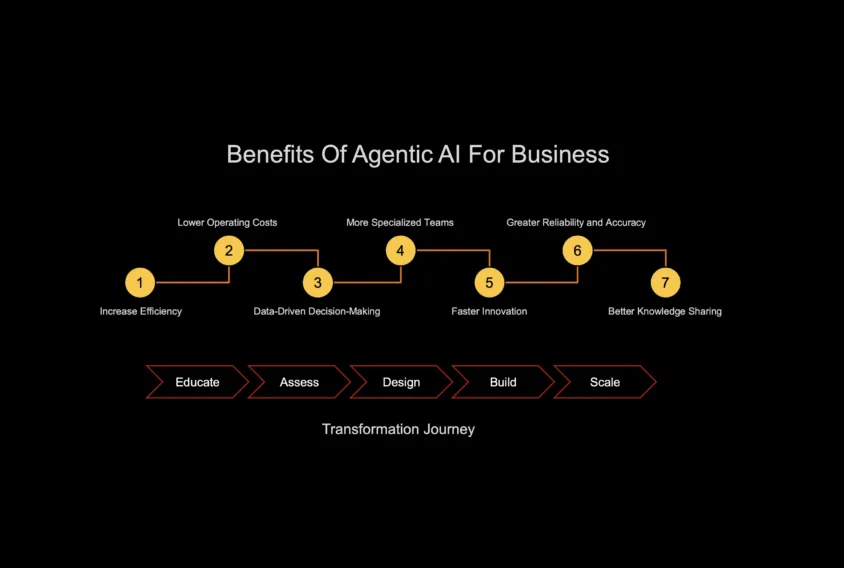
Focus Point: Transformation Journey
Rather than focusing solely on technology, MMC helps organizations navigate the complete Agentic AI transformation journey, from building foundational knowledge and identifying opportunities to deploying production-ready agent and scaling successful solutions across the enterprise.
A simple consulting journey could be: Educate → Assess → Design → Build → Scale.
Educate: Begin with an Agentic AI awareness session that provides a clear understanding of what Agentic AI is, how it differs from traditional AI and automation, and the opportunities and limitations it presents. Identify where Agentic AI can create value within the organization and make informed decisions about adoption and investment.
Assess & Identify Opportunities: Understand the organization’s goals, workflows, and pain points. Evaluate where Agentic AI can create the most value by automating repetitive tasks, supporting decision-making, or improving operational efficiency. The outcome is a prioritized list of use cases with clear business impact.
Design the Agent Solution: Define the agent’s objectives, scope, and success metrics. Determine what tools, data sources, and systems the agent will need to access, along with any human oversight, security controls, and governance requirements. This creates a blueprint for a practical, responsible, and scalable AI solution that aligns with both business goals and user needs.
Build & Integrate: Develop a pilot agent focused on a high-value use case, such as customer support, sales research, or workflow automation. Connect the agent to relevant business systems, databases, and applications so it can operate within existing processes and deliver measurable results.
Govern & Scale: Establish monitoring, access controls, performance metrics, and compliance measures to ensure reliable operation. Once the pilot proves successful, expand to additional use cases, departments, or multi-agent workflows, creating a roadmap for broader adoption and continuous improvement.
By following the Agentic AI Consulting Journey, organizations gain the knowledge, strategy, and capabilities needed to successfully adopt Agentic AI in a controlled and value-driven manner.
The outcome is a clear roadmap for implementation, prioritized use cases aligned to business objectives, and production-ready AI agents that enhance productivity, improve decision-making, and automate complex workflows. Through effective governance and continuous optimization, organizations are positioned to scale Agentic AI confidently, delivering sustainable business value and competitive advantage.
Foundation Model (Reasoning Engine)
At the core of most agentic systems is a large language model (LLM) or multimodal model that interprets inputs, generates plans, reasons about tasks, and decides on next actions. This model serves as the agent’s “cognitive engine,” converting goals into executable steps and synthesizing information from multiple sources.
Modern foundation models can perform chain-of-thought-like reasoning, summarize observations, evaluate alternatives, and generate structured outputs. However, by themselves they are limited by context windows, knowledge cutoffs, and lack of direct interaction with external systems, which is why additional components are required.
Memory Systems
Memory enables an agent to retain information beyond a single interaction. Short-term memory stores the current conversation, task state, and intermediate results, while long-term memory stores user preferences, prior experiences, learned patterns, and historical outcomes.
Effective memory architectures often combine vector databases, knowledge graphs, and structured storage systems. This allows agents to retrieve relevant information when needed, improving personalization, continuity, and decision quality over extended periods.
Planning and Task Decomposition
Planning modules break complex objectives into smaller, manageable subtasks. Rather than immediately generating a final answer, an agent can create a sequence of actions, determine dependencies, prioritize activities, and monitor progress toward a goal.
Advanced planners may use techniques such as hierarchical planning, tree search, or iterative refinement. This capability is particularly important for long-running tasks such as software development, research, business process automation, and workflow orchestration.
Tool and Environment Integration
Agentic AI becomes significantly more powerful when connected to external tools and systems. These may include search engines, databases, APIs, enterprise applications, calculators, code execution environments, robotic controllers, or business software.
Tool use allows the agent to access real-time information, perform computations, execute transactions, and interact with the external world. The agent must determine when a tool is needed, select the appropriate tool, formulate requests, and interpret the results.
Decision-Making and Control Layer
The control layer governs how the agent selects actions and manages execution. It evaluates available options, balances risks and rewards, handles exceptions, and decides whether to continue, revise, or terminate a plan.
This layer often includes policies, confidence thresholds, guardrails, and state management mechanisms. In multi-agent systems, it may also coordinate communication and task allocation among multiple specialized agents.
Feedback and Learning Mechanisms
Agentic systems improve through feedback loops. After performing an action, the agent evaluates outcomes, compares results against objectives, and adjusts future behavior accordingly.
Learning may occur through reinforcement learning, human feedback, self-reflection techniques, performance monitoring, or continuous knowledge updates. These mechanisms help agents become more accurate, efficient, and adaptable over time.
Safety, Governance and Monitoring
Because agentic AI can act autonomously, robust safety controls are essential. Governance mechanisms define what actions are permitted, enforce compliance requirements, maintain audit trails, and prevent harmful or unauthorized behavior.
Monitoring systems track agent decisions, tool usage, and performance metrics in real time. Human-in-the-loop oversight is often incorporated for high-risk domains such as healthcare, finance, cybersecurity, and critical infrastructure.
Explore Further
Focus Point: How To Build An Agent(s) And An Orchestration Layer
Building an AI Agent
Building an AI agent starts with defining a clear objective, the tools it can access, and the decisions it is expected to make autonomously. At its core, an agent consists of a foundation model (typically a large language model), memory, planning capabilities, and tool integrations. When a user provides a goal, the agent first interprets the request, creates a plan to achieve it, retrieves any relevant information from memory, and then invokes external tools such as databases, APIs, search engines, or enterprise applications as needed. The agent continuously evaluates the results of its actions and adjusts its approach until the objective is completed. This combination of reasoning, planning, memory, and action distinguishes an agent from a chatbot that responds to prompts.
From a Single-Agent to a Multi-Agent Architecture
As agent workloads become more complex, organizations often move from a single-agent architecture to a multi-agent architecture. In this approach, multiple specialized agents are created, each responsible for a specific function or domain. For example, a research agent may gather information, an analysis agent may interpret the data, and a reporting agent may generate insights or documentation. Specialization improves performance because each agent can be optimized for a particular task, use a distinct set of tools, and maintain its own memory and operating instructions. Multi-agent systems are particularly useful for complex business processes, software development, research automation, and enterprise workflows where tasks require diverse expertise.
Agent Orchestration
Agent orchestration refers to the coordination and management of these multiple agents to ensure they work together effectively. Orchestration determines which agent performs which task, how information is shared, the sequence of execution, and how results are consolidated. A common orchestration pattern is the supervisor model, where a central coordinator agent receives a user request, decomposes it into subtasks, delegates those tasks to specialized agents, and then combines the outputs into a final result. Other orchestration approaches include sequential workflows, where agents operate one after another, and parallel workflows, where multiple agents work simultaneously and their outputs are merged later.
Orchestration Support
To support orchestration, agents typically communicate through shared memory systems, databases, message queues, or event-driven architectures. These mechanisms enable agents to exchange information, maintain awareness of task progress, and coordinate their actions without direct human intervention. Modern frameworks such as LangGraph, LangChain, CrewAI, AutoGen, Semantic Kernel, and the OpenAI Agents SDK provide infrastructure for managing agent communication, state, workflow execution, and governance. In practice, many successful enterprise implementations begin with a single agent and gradually evolve into a supervisor-led multi-agent system as requirements for scale, specialization, and automation increase. This incremental approach simplifies development while establishing a foundation for more sophisticated agentic AI capabilities.